Geribi Deruta Italy
Reproduction
Reproduction
Couldn't load pickup availability
Share
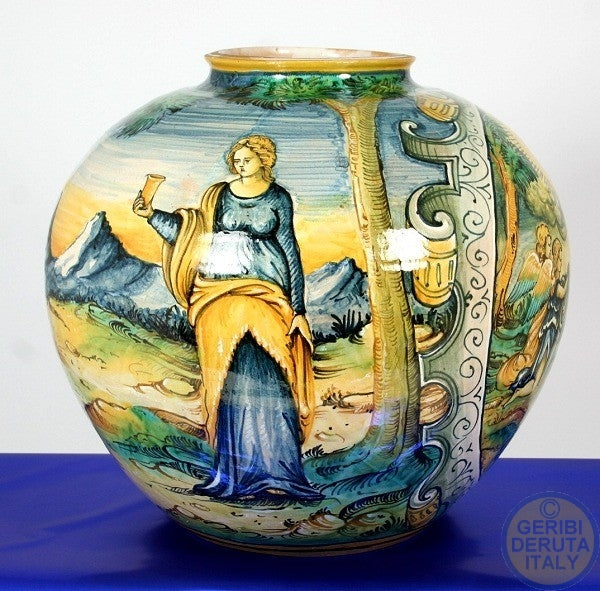
This object is a faithful Renaissance-style maiolica reproduction, made using the same materials and techniques employed in central Italy around the early–mid 1500s, particularly in workshops like those of Deruta.
Description (historically grounded):
The vessel is a globular maiolica vase with a narrow foot and slightly flared neck, thrown on a wheel from refined earthenware clay. After the first firing (biscotto), the surface was coated with a tin-opacified glaze, producing the characteristic opaque white ground that Renaissance potters used as a “ceramic canvas.”
The decoration was painted freehand with metallic oxide pigments—primarily cobalt blue, copper green, antimony yellow, manganese brown, and iron red—before the final firing, exactly as in the 16th century. No modern overglaze or decals are involved.
At the center is a sacred biblical scene, likely inspired by Old Testament iconography common in Deruta production: a bearded male figure with a halo guiding a young child, rendered in soft, classical proportions. The figures are framed by a pastoral landscape with stylized hills and clouds, painted in the narrative istoriato style that became popular in the early Cinquecento.
Surrounding the scene are grotesque and arabesque motifs, vegetal scrolls, and symmetrical flourishes derived from Roman decorative vocabulary rediscovered during the Renaissance. The border patterns and ribboned cartouche reflect designs seen in authentic Deruta wares from circa 1500–1530.
The glaze surface shows slight pooling and subtle tonal variation—intentional and historically accurate—resulting from wood-kiln firing and natural flux movement, rather than industrial uniformity.
In short:
This piece is not merely “inspired by” the 1500s—it is a technical reconstruction of Renaissance maiolica, executed with:
-
wheel-thrown earthenware
-
tin-glaze (smalto)
-
hand-painted oxide pigments
-
single high-temperature glaze firing
Exactly as a Deruta workshop master would have done five centuries ago.